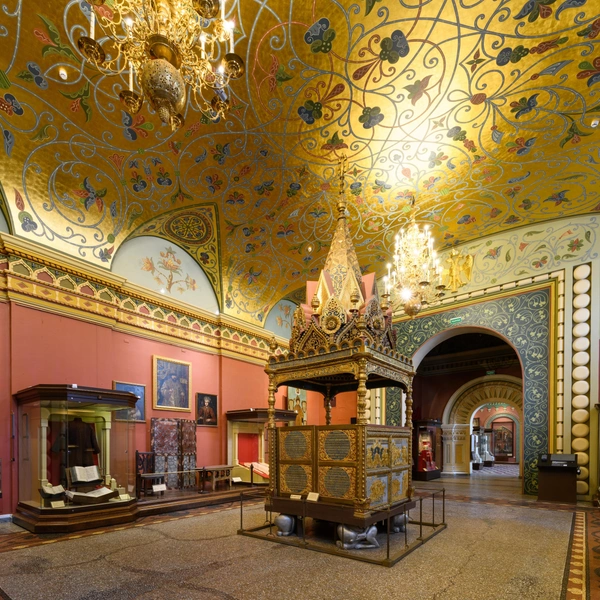
For nearly a century and a half, Moscow’s Red Square has been graced by the majestic building of the Historical Museum, built between 1875 and 1883 specifically to house Russia’s national treasury. One of Moscow’s oldest museums owes its existence to the grand All-Russian Polytechnic Exhibition. The museum’s creation was initiated by the organizers of its Sevastopol department, dedicated to the heroic defense of Sevastopol during the Crimean War, as well as the exploration of ancient Chersonesos. On February 9, 1872, Emperor Alexander II granted «highest permission» to establish the Historical Museum named after Tsarevich Alexander Alexandrovich in Moscow. This date is considered the founding day of the future State Historical Museum. The idea of creating a museum of national history brought together many people—scientists, military personnel, artists, industrialists, statesmen, members of the royal family, and ordinary citizens. The Moscow City Duma donated a plot of land on Red Square, originally planned for the museum’s own building, for construction. In August 1875, Emperor Alexander II personally laid the foundation stone for the future museum. On May 27, 1883, during the coronation celebrations, Emperor Alexander III and Empress Maria Feodorovna visited the Historical Museum.
Thanks to the contributions of patrons and donors, the museum rapidly expanded its collection—Shchukin, Bakhrushin, Zabelin, Catoire de Bioncourt, Uvarov, Shcherbatov, and many others donated their collections to the common cause, which had nothing to do with personal glory or profit. Thanks to the efforts of the museum’s founding fathers, its trustees, directors, and ordinary employees, whose dedicated work preserved and expanded its priceless collections, today the State Historical Museum is one of the largest museums in the world. Priceless archaeological, numismatic, ancient literary, weaponry, and works of fine and applied art are kept here.